330: I Just Want a Dog

330: I Just Want a Dog
Embedded.fm

Chris Svec (@christophersvec) chatted with us about going from engineer to manager and working from home. 

Chris had many book recommendations (these are affiliate links):

Chris is hiring for his team. Check out the iRobot Jobs page or look at the specific jobs he’s hiring for (in Boston, MA): Associate Software Engineer and Principal Software Engineer.

Chris gave a talk to Purdue students about working from home, there is a video and a summary blog post.

An interesting tweet about the difference between working from home and what people are doing now. The Canadian Federal government gave the following advice:

EXxX5B5X0AAhTth.jpg


Finally, Svec’s family wants a cat. They probably won’t get a Sphinx despite it matching all the criteria. Maybe an Abyssinian. Or maybe a dog.

image (3).png

190: Trust Me, I’m Right (Repeat)

190: Trust Me, I'm Right (Repeat)
Embedded.fm

Matt Godbolt (@mattgodbolt) spoke with us about settling arguments with Compiler Explorer.

March Micro Madness is here!

Compiler Explorer comes in different flavors:

You can see the beta version by putting a beta on the end:  https://gcc.godbolt.org/beta/

This a fully open source project. You can read the code and/or run your own version:

Matt works at DRW working on low latency software. Note that DRW is hiring for software engineers. You can read about the evolution of Compiler Explorer on their blog.

Matt’s personal blog is xania.org. You might like parts about 6502 Timings. He also has several conference talks on YouTube including x86 Internals for Fun & Profit and Emulating a 6502 in Javascript. Matt was previously at Argonaut Games.

Jason Turner of C++ Weekly and his C++17 Commodore 64

Could a Neuroscientist Understand a Microprocessor? paper (with a nod to Don’t Panic GeoCast’s Fun Paper Friday)


327: A Little Bit of Human Knowledge

327: A Little Bit of Human Knowledge
Embedded.fm

Daniel Situnayake (@dansitu) spoke with us about machine learning on microcontrollers.

Dan is the author of TinyML: Machine Learning with TensorFlow Lite on Arduino and Ultra-Low-Power Microcontrollers. You can read the first several chapters at tinymlbook.com

TinyML is a part of TensorFlow Lite. See the microcontroller getting started guide.

Dan works for Edge Impulse (@EdgeImpulse) which is making tools for easier machine learning integration at the edge. Their tools are free and they also have a getting started guide.

Dan recently posted on the Edge Impulse blog about training a TinyML model to capture lion roars.

For TinyML meetups and a forum, check out tinyml.org

Lacuna Space: low cost sensors transmitting to space

The Rainforest Connection is using small sensors to monitor for chainsaw sounds


325: Hasn’t Been R2D2'd

325: Hasn’t Been R2D2'd
Embedded.fm

John Saunders (@NYCCNC) spoke with us about building a Johnny Five robot on his NYC CNC YouTube channel (https://www.youtube.com/user/saunixcomp)

You can find all of the Johnny Five build videos on a playlist or check out the NYC CNC page. As mentioned, Input Inc did a lot of the preliminary work.

John recommends books:

John is also the founder of Saunders Machine Works (they have a contact page).

How Johnny Five got his name

324: I’ll Let You Name Your Baby

324: I’ll Let You Name Your Baby
Embedded.fm

Adam Wolf (@adamwwolf) of Wayne and Layne (www.wayneandlayne.com) spoke with us about making kits, museum exhibit engineering, working on KiCad, and extraterrestrial art philosophy.

Adam has a personal blog on www.feelslikeburning.com/blog/ as well as a website adamwolf.org. Adam co-wrote Make: Lego and Arduino Projects

If you want to know how to contribute to KiCad libraries, check out their instruction page: kicad-pcb.org/libraries/contribute/

We also mentioned:

IMG_0177.jpeg


207: I Love My Robot Monkey Head (Repeat)

207: I Love My Robot Monkey Head (Repeat)
Embedded.fm

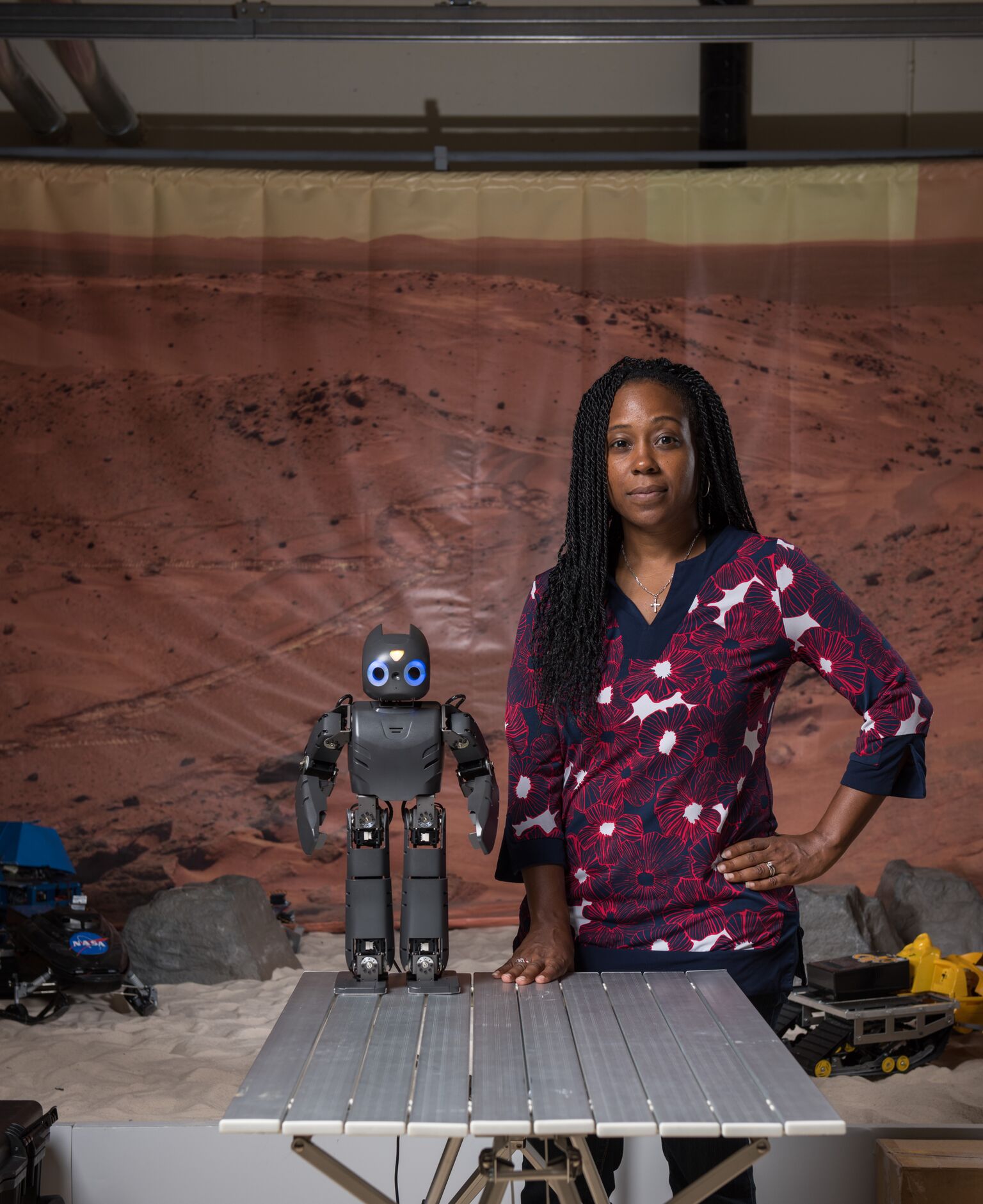
Professor Ayanna Howard of Georgia Tech joins us to talk about robotics including how androids interact with humans.  Some of her favorite robot include the Darwin, the Nao, and, for home-hacking, the Darwin Mini.

Ayanna has a profile on EngineerGirl.org, a site that lets young women ask questions of women in the engineering profession.

Elecia has been working on a typing robot named Ty, documented on the Embedded.fm blog. It uses a MeArm, on sale in July 2017 at Hackaday.com, with coupon noted in show. (don't use PayPal to check out or you can't apply the coupon). 

Other robots for trying out robots: Lego Mindstorms (lots of books, project ideas, and incredible online tutorials!), Cozmobot, Dash and Dot. Some robotics competition leagues include Vex, Botball, and FIRST

323: Snail Appnote

323: Snail Appnote
Embedded.fm

Carmen Parisi spoke with us about changing jobs from a semiconductor specialist at TI to an electrical engineering generalist at Wasatch Photonics. 

Carmen was previously on Embedded 216: Bavarian Folk Metal and formerly was the host of  The Engineering Commons podcast 

Carmen works at Wasatch Photonics making Ramen Spectrometers.

Spudger

Tag Connect board edge connector

321: The Edge of Science Fiction

321: The Edge of Science Fiction
Embedded.fm

Jason Derleth of the NASA Innovative Advanced Concepts Program spoke with us about what it takes to win a NIAC award.

We first heard about NIAC talking to Ariel Waldman. Her niacfellows.org site has some advice and encouragement for applying. Ariel was on Episode 255 of the show.

Elecia’s one-page overview of Curved-Crease Origami and Flex Circuitry for In-situ Planetary Science Sensor Arrays.

320: Why Isn’t This Working?

320: Why Isn't This Working?
Embedded.fm

Chris Gammell (@Chris_Gammell) of The Amp Hour and Contextual Electronics joined Christopher and Elecia to talk about firmware, learning, and books.

Chris is the host of The Amp Hour, a podcast about electronics and electrical engineering. Chris is also the founder of Contextual Electronics, where you can go to learn how to create electronics. Chris has a long running blog called Analog Life, found on his webpage chrisgammell.com,

Chris is learning firmware as part of his consulting business. He likes Elecia’s Making Embedded Systems book.

KiCon is happening at CERN in September 2020. More information at 2020.kicad-kicon.com.

We talked about Jay Carlson who was on Embedded talking about his Amazing $1 Microcontroller project (#226) and about teaching embedded systems (#303)

We talked about book club books:

And a fun book series called Bobiverse (the Audible version is especially good).

(The outro music is Chris W.’s attempt to troll Chris G. with his “lightning” round answer)

319: Squidly Tentacles

319: Squidly Tentacles
Embedded.fm

Chris (@stoneymonster) and Elecia (@logicalelegance) chat about the year 2038, their projects, their new finds, and future shows.

The year 2038 problem is real. Elecia read some of this tweet thread about it.

Single file libraries list on github: (https://github.com/nothings/single_file_libs), including the STB image handling library Chris was originally looking for.

Chris is working on a MIDI project with a NUCLEO-144 (STM32F303ZE) board and various breakout boards from Adafruit and Sparkfun.

Elecia talked about the NASA Innovative Advanced Concepts Program (NIAC) and curved crease origami. She also talked about PID controllers and Tiny ML.

We are now soliciting sponsorship!

211: 4 weeks, 3 days (Repeat)

211: 4 Weeks, 3 Days (Repeat)
Embedded

Dennis Jackson spoke with us about making the career shift from software to embedded.

Dennis buys James Grenning’s Test Driven Development in Embedded C for his new hires and often recommends Elecia’s Making Embedded Systems. His tip that everyone should know was “Learn make!” and he has a reference for that: Why Use Make.

He suggested Joel Spolsky’s reading lists from Joel On Software, even the ones that don’t obviously apply.

Additional suggested-reading articles:

In his previous appearance on Embedded (#94: Don’t Be Clever), we talked about code complexity and measuring cyclomatic complexity. At that time he wanted a tool to monitor the code’s status. He has since found one: pmccabe.


318: Amazed at How Things Are Amazing

318: Amazed at How Things Are Amazing
Embedded.fm

Darryl Yong (@dyong) is a mathematics professor at Harvey Mudd College (and former classmate of ours, also at HMC). He is working with HMC’s Clinic Program, putting real industry projects in front of teams of college students. He’s also teaching number theory to prison inmates and helping teachers in the chronically underfunded Los Angeles Unified School District.

Darryl writes about his career in education at Adventures in Teaching (profteacher.com). You can read about his experiences with the Inside-Out Prison Exchange Program.

If you dig into the archives a bit (2009) you can read about teaching at a high school, for example adapting teaching to different students. What he took away led him to create Math for America Los Angeles, a non-profit organization dedicated to increasing the number of secondary school mathematics and computer science teacher leaders in the greater Los Angeles Area.

Darryl’s personal page (darrylyong.com) and his HMC page (math.hmc.edu/~dyong). Also, check out HMC’s Clinic Program page.

317: What Do You Mean by Disintegrated?

317: What Do You Mean by Disintegrated?
Embedded.fm

We were joined in the studio by the Evil Mad Scientists Lenore Edman (@1lenore) and Windell Oskay (@oskay).

Evil Mad Scientist Laboratories (@EMSL) produces the disintegrated 555 Timer kit and 741 Op-Amp  kit. These were made in conjunction with Eric Schlaepfer, who also created the Monster 6502

EMSL also makes the Eggbot kit and AxiDraw not-kit (and mini-kit). For a history of the pen plotter, check out Sher Minn’s Plotter People talk on YouTube.

(They have too many neat things to list here, go look on their page: https://shop.evilmadscientist.com/directory. Or stop into their Sunnyvale, California shop.)

We talked about the beauty of boards including Kong Money and ElectroCookie’s candy colored shields and Arduino Leonardo.

Jepson Herbarium has interesting workshops including one about seaweed. At one workshop, Lenore and Windell got to talk to Josie Iselin, author of The Curious World of Seaweed

Elecia enjoyed Slime: How Algae Created Us, Plague Us, and Just Might Save Us by Ruth Kassinger.

Windell was previously on Embedded episode #124: Please Don’t Light Yourself on Fire, we mainly talked about the book he co-authored: The Annotated Build-It-Yourself Science Laboratory.

Lenore was previously on Embedded episode #40: Mwahaha Session, we talked about EMSL.

Our post-show tidepooling was very successful with a variety of nudibranchs, shrimp, seaweed, sea birds, snails, and hermit crabs.

Transcript

IMG_6522.jpeg

315: Trespassers William

315: Trespassers William
Embedded.fm

Chris and Elecia talk with each other about non-work activities including music, office rearrangement, and origami.

The Solarbotics Squid Hunting CearouSol Kit

Samson S-patch plus 48-Point Balanced Patchbay

Waldorf Blofeld Synthesizer

EarthQuaker Devices Rainbow Machine V2 Polyphonic Pitch-shifting Modulator Pedal (with Magic knob)

Artelino is a Japanese print auction house


Thank you to the Embedded Patreon supporters!

314: Why Are Wings Needed in Space?

314: Why Are Wings Needed in Space?
Embedded.fm

Mohit Bhoite (@MohitBhoite) makes functional electronic sculptures from components and brass wire. We spoke with him on the hows and whys of making art.

Mohit’s sculptures, including the Tie Fighter. More on his instagram: mohitbhoite

Jiri Prause has a wonderful tutorial on how to make simpler freeform electronics on Instructables.

Peter Vogel is another artist making phenomenal freeform electronics.

Leonardo Ulian uses electronic components in his art (his don’t function but wow).

Advice from Mohit on trying this yourself from Bantam Tools. Mohit likes Xuron Pliers

Donate to DigitalNest by the end of 2019 and get your donation matched! Thank you to the listener who is doing the match!